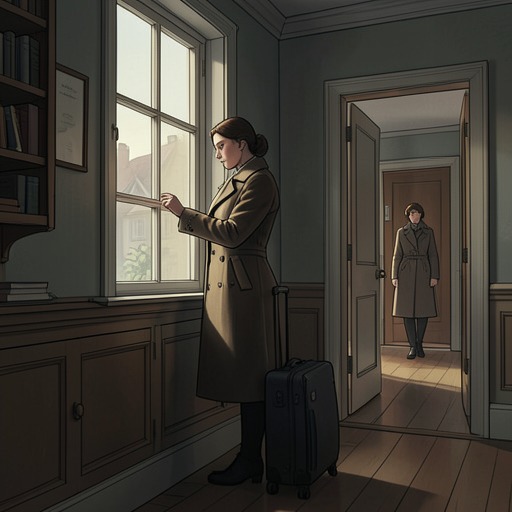
Christopher’s parents’ marriage
The Curious Incident of the Dog in the Night-TimeChristopher’s parents’ marriage deteriorates through arguments over family life and Christopher’s needs, then ends in separation. Its consequences continue long after Mother leaves: Father conceals the separation from Christopher, and the parents’ eventual confrontation exposes the competing accounts of care and responsibility that have shaped their family.
The marriage under strain
Mother’s account, given in a letter to Christopher, describes a household in which she and Father responded differently to pressure. She says that Father was more patient and tended to carry on without showing when something upset him, whereas she became cross more readily. After a difficult incident while shopping with Christopher, she and Father argued; she says that she struck him during the argument, and that conflicts of this kind became frequent. Over time, they stopped talking because conversation seemed likely to end in another argument, and she felt lonely.
A later dispute over Christopher’s food made their different approaches to his care especially plain. Mother says she was trying to get him to eat something healthy, while Father argued that she should give him what he would eat, even if that meant lettuce or a strawberry milk shake. After another argument, Mother found herself watching Father and Christopher together and seeing them as calmer with one another than she was with Christopher. She felt excluded, and began to think that Father and Christopher might be better off without her living in the house. Her letter presents that judgment as part of the reasoning behind her eventual departure, not as proof that she no longer cared for her son.
Separation and concealed truth
The marriage’s rupture becomes visible to Christopher when Father returns after being away for two and a half hours and tells him that he will not see his mother for a while. Father looks out of the kitchen window rather than at Christopher as he says this. Christopher finds the lack of eye contact easier than the usual uncertainty of trying to interpret what another person is thinking, but the news itself leaves the family separation unexplained.
Mother’s letter supplies her own account of leaving. She says that she had begun spending time alone with Roger because she could talk to him and no longer felt lonely with him. She and Roger came to love one another, and he proposed that they leave their respective partners and live together. Mother initially said she could not leave Christopher. Later, after Roger arranged a transfer to a job in London and asked her to go with him, she decided to leave, believing that this might be better for everyone. She intended to return, explain, and continue seeing Christopher, but says Father told her she could not come back or speak to him. She therefore wrote letters instead.
Father’s account of the concealment is not the same as Mother’s. When confronted with the letters, he says he had intended to show them to Christopher when he was older and insists that he had not meant to lie. He explains that Mother left a note and later called, and that he told Christopher she was in hospital because he did not know how to explain the situation. He acknowledges that this was untrue, but says that once he had said it, he could not change the story and it got out of control. His stated intention to protect Christopher does not undo the effects of the deception: Christopher has to discover for himself that his mother is alive and that his father withheld the truth.
Care, conflict, and responsibility
The parents’ accounts also illuminate the family’s competing definitions of care. Mother’s letter emphasizes how she felt lonely, overwhelmed, and increasingly out of place in the relationship between Father and Christopher. Father later describes his own practical responsibilities in emphatic terms: he cooked Christopher’s meals, cleaned his clothes, cared for him on weekends and when he was ill, took him to the doctor, worried when he wandered off, and went to school when he got into fights. During the confrontation in London, he uses that list to challenge Mother’s role, contrasting years of hands-on care with her letters.
That argument does not resolve the conflict so much as show how differently each parent measures parental presence. Mother’s letters are evidence of her effort to communicate after leaving, but Father treats them as inadequate beside the daily work he says he performed. Mother, in turn, objects that Father told Christopher she was dead. Their clash joins the breakdown of the marriage to a more immediate breach between parent and child: the dispute is not only about who cared for Christopher, but also about who had the right to tell him what had happened.
The relationship with Roger further complicated the separation. Mother describes him as someone with whom she could speak and says that he was lonely too; Father later says that after Mother left, Mrs. Shears helped him through a difficult period, and that he hoped she might eventually move in with him or that they might live at her house. He says that he and Mrs. Shears argued and that she eventually made him leave. These accounts connect the parents’ separation to new relationships and expectations, but they do not make the two situations interchangeable: Mother’s departure and Father’s later hopes are narrated from different perspectives and lead to different conflicts.
The marriage after separation
The parents’ separation remains active in the family’s life after Mother returns to London and Christopher stays in the flat. At 2:31 a.m., he wakes to shouting and recognizes Father among the people arguing. The narration records the raised voices and Christopher’s fear, but does not present the exchange as a settled reconciliation. Instead, the scene makes the former marriage a continuing source of conflict within the household Mother now shares with Roger.
When Mother decides they must return to Swindon, she says that if they remain in London longer, someone may get hurt, though she does not necessarily mean Christopher. The drive takes three hours and twelve minutes. At the house, Mother asserts that it is hers too; later, when Father arrives, she and Father argue while Christopher moves the bed against his door to keep Father from entering his room. The return therefore brings Mother back to the shared family home without restoring the marriage or removing the distrust surrounding it.
The marriage is presented through partial, competing accounts rather than a single authoritative explanation. Mother’s letter gives Christopher the history Father concealed, while Father’s later outbursts expose his own sense of labor, loneliness, and loss. Their separation rearranges who lives with Christopher and who provides care, but does not end their claims on the family or on the meaning of what happened. For Christopher, the decisive consequence is that the adults’ marital conflict becomes inseparable from the truth he can trust.